Feliz Ano Nuevo

With our truncated stay in Buenos Aires due to our travel delays, we were unable to do any of our scheduled tours. We got to our hotel, caught up with our friends Doug and Kip, showered, ate and went to bed. The dinner at the hotel was a multi course New Year’s Eve special, complete with wine and champagne and cost an astounding 150000.00 pesos per person (about one hundred dollars each).

Portenos, as residents of Buenos Aires are called, have a low key approach to New Year’s Eve . They tend to eat dinner very late, and a celebratory dinner is usually it for the evening. We didn’t see or hear any fireworks or other signs of celebration, so we fit right in.

After a good night’s sleep we had breakfast at the hotel and then headed for Aeroparque Jorge Newberry for our flight to San Martin de los Andes. We tried to use the kiosk to get our boarding passes and seat assignments and were informed that the flight was overbooked and there were no available seats. That’s when the PTSD set in.

The line to the check in desks stretched through the airport, but moved fairly quickly. We got to the desk, got the last four seats on the plane and breathed a sigh of relief. Security, passport verification, boarding passes, x-Ray machine and all the little indignities we put up with to fly meant nothing. We had seats on the plane!

Our flight to San Martin was about two hours, and most of the flight was over flat farms and ranch land that looks very similar to the great plains of the United States: fields laid out in a grid pattern, with occasional irrigated crop circles, ponds and small lakes. Some bodies of water were green with algae, and others were white either along the shore or in their entirety, probably due to pollution.

When we thought we might not get seats on the plane we checked the possibility of driving to San Martin de Los Andes-18 hours by car! That’s when the size of Argentina became real; with primarily a north/south orientation, it’s over two thousand miles from Ushuaia in the far south to Buenos Aires. There is no reliable train system and the roads are not very good. Flying is the only way to go, and the do have a robust domestic flight network including Aerolineas Argentinas and a couple of budget airlines

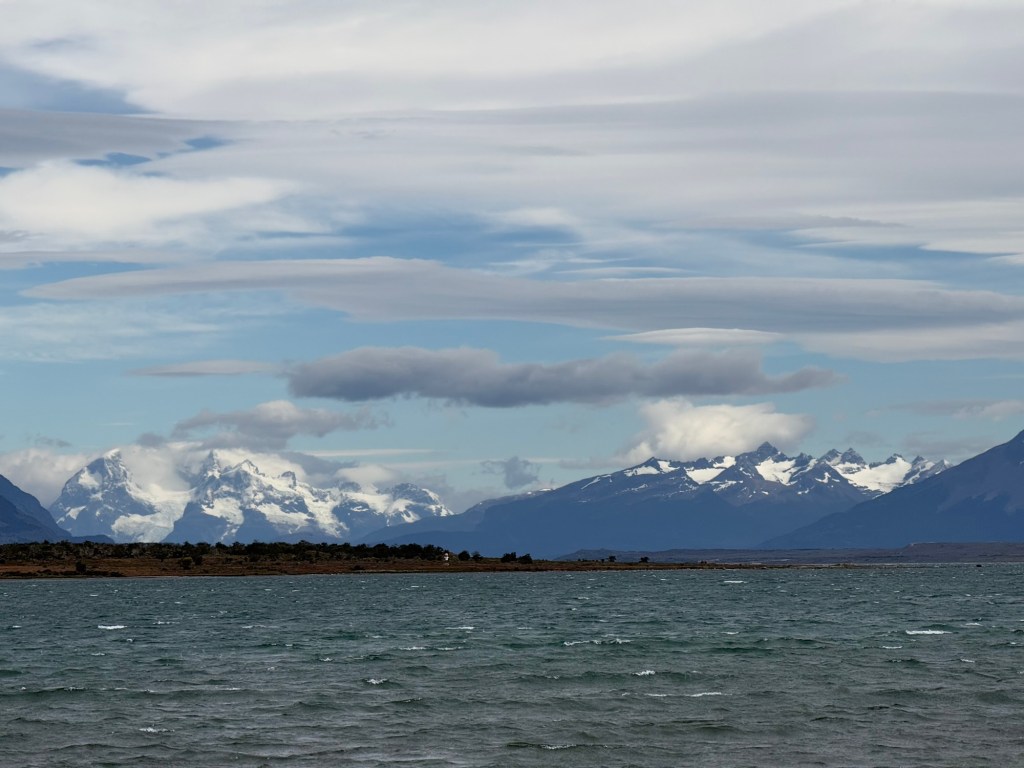
We checked in to Hotel Viejo Esquiador(the hotel of the old skier) and walked to Lago Lacar, a beautiful glacial lake at the west end of town.

Lago Lacar

We had a nice dinner at Abasto restaurant next to the hotel and then went to bed. Argentinians keep late hours so we didn’t finish dinner until after 11:30.

Plan C

As the complexity of your travel plans increases, the chance that something will go wrong also multiplies. So while the Delta Airlines solution to get us to Argentina might work, with three plane changes along the way we could easily face more problems. With that in mind other solutions were needed. We considered driving to JFK, about 6 hours from home, but things were already stacked up there with delayed and cancelled flights, and the earliest we could get out there was two days from now.

The other possibility was Toronto, which is only three hours from home. As it turned out we could get a flight on the 30th that would get us into Buenos Aires by 3:30 on December 31, in time for our New Year’s Eve dinner, a restful sleep and easy departure for San Martin de los Andes on New Year’s Day for our fly fishing.

Bags were already packed, so we loaded them into our daughter Sarah’s car and set off for Toronto. The border crossing was easy, roads were dry, and traffic was light. We reached the airport by 7 PM for an 1155 PM departure on Avianca Airlines. Dinner at the airport, kill some time window shopping, board the plane and off we go. Next stop Bogota, Colombia.

Travel is glamorous only in retrospect- Paul Theroux

Flights booked, bags packed, itinerary laid out. Today’s the day we start for Argentina, with nearly six weeks of travel and adventure ahead. Rochester to New York to Buenos Aires. Two flights, sixteen hours, two hemispheres before touchdown on a new continent in a new Country .

That was the plan, and we were just heading to the airport when the first text message arrived. Flight delayed at JFK; only half an hour, no problem. It was the second text that was the problem.

“We’re sorry that your flight DL5289 from Rochester to New York, NY is cancelled. We have been working to find a good option for you, but unfortunately, we didn’t find a flight on which to automatically rebook you.”

Four phone calls, 30 minutes on hold and 3 agents later, the best we could do was a 6 AM flight from Syracuse to Atlanta to Miami to Buenos Aires two days from now. Cancel the hotel in Buenos Aires, cancel the New Year’s Eve dinner with friends, cancel the tango tour and the introduction to Buenos Aires tour. If this works out, we’ll get to BA at 4:20 AM on January 1, 2026, then catch a 12:55 PM Flight to San Martin de los Andes for a few days of fly fishing on the Limay River in Patagonia.

I remain an optimist.

We’re getting the band back together!

The Wormer Family Band started as a way to document our family’s trip to France and Italy in 2015. Since then, two of our children have married, and we have 3 grandchildren, with another on the way. Our other two children have flown the coop and are living and working in Pittsburgh and Buffalo. It’s been eight years since our last post and much has changed. I have retired, Melissa is more involved than ever in volunteering, and we have been doing an outrageous amount of traveling. Last year we visited Egypt and India and France. Coming up we have a trip to Argentina, a safari in Africa and a wedding in Tuscany. With all this in our future I’ve decided to revive the blog, both to keep track for ourselves of where we’ve been and what we’ve seen and to share our adventures with others. We hope you’ll come along!

Jet Lag

We’ve been home for 3 days now, and are still feeling the effects of travel.  I’ve never suffered from a serious case of jet lag before, but I’ve got it now.  After 3 weeks abroad, as well as the heat, walking and excitement of the trip, I’m really beat.  Melissa slept for 12 hours last night and is starting to recover.  I’m back at work but feel achy and fuzzy headed.  Some of this may also be allergies . . . .

Well, that’s how things were two weeks ago.  I subsequently developed headache, sore throat, myalgias and a temperature of 102F.  That’s right, I had the flu.  For the next week I felt miserable.  I still have little energy and a slight cough, but am otherwise recovered.  So where did I get the flu?  Well, personally I think it was at the Vatican Museum with that throng of people being herded through the galleries, but the airplane would be another good bet, and then there’s that Pope water we drank at the catacombs.  At any rate I was the only one to become ill, so the rest of the family carried on.  Matt and Sam are still overseas, most recently in Athens.

Back to reality

The day has finally arrived.  After three weeks of travel and fun we’re headed home.  Matt and Sam were out the door by 4:00 a.m. for a very early flight to Dubrovnik.  At 4:30 my phone rings- Matt has left his camera by the door to our apartment;  it’s still there, beneath the rear tire of a parked car. No way to get it to the airport though.  As I walk back into the apartment using my phone as a flashlight I somehow hit ‘FaceTime’  which is an app I never use.  There is a voice over the speaker.  I’ve somehow dialed my old college roommate Rich Scott.  He’s in San Francisco on business and fortunately it’s early evening there so we have a brief chat – half a world away.

Rich Scott

Rich Scott

We’re up by 7:30 and begin the arduous task of packing for the flight home.  With our new suitcase things are easier. Books, shoes and our never used raincoats all go in the  new bag, to be checked through to Toronto.  It weighs a ton and I hope the cheap thing doesn’t split wide open when we move it.  Gratefully our other bags are now lighter and more manageable.  Final packing done and the apartment looking pretty good, we wait for the car to the airport.  It arrives shortly before 11:00, and we’re off for Fiumicino Airport.  On a Saturday morning the traffic is light and we’re there in plenty of time.  Driver paid, we enter the terminal.  New suitcase makes it to the check in desk and is weighed.  The Alitalia staffer looks at it warily, but checks it through- the benefit of flying business class.  Next is security, and we’re through that quickly.  Sarah and Margaret are off to the Air Transat gate, and Melissa and I have a final espresso while we wait for the plane to board.

image

Now normally when you’re flying a trans- Atlantic flight on a big plane you have a pleasant stroll to the plane down a walkway.  But there was a fire at Fiumicino in May and we are forced to ride two shuttles to get to our plane, which is sitting far out on the runway.  They keep us locked in the shuttle while several disabled passengers are helped up the stairs. We then climb mountainous stairs to reach the plane ourselves.

Settled in to our seats we relax and await the take-off.  Here we go.  Dinner, drinks, fold flat seats, its all there.  But I can’t relax.  The vacation ending, all those daily tasks and worries that run our lives come flooding in.  Is the grass mowed, are the cats alright, do I have a mountain of paperwork on my desk(of course).  Still, I try to doze and watch a movie.  There is a camera on the plane that allows you to see the earth below.  Except the earth below is covered with clouds for the entire trip.  Still it’s a nice idea, and I check it repeatedly over the nine hour flight.  Finally, about 30 minutes out of Toronto I can see the earth.

IMG_2216_1024

Plane landed, we get through customs easily, wait for our new suitcase, which arrives intact although barely- the zipper is half open and the plastic on one side is starting to tear.  Shuttle to the car is right outside, and we reach the car quickly.  We open the car door, and there is that damned GPS, upside down on the seat, and nearly invisible.  Oh well.  The ride home is uneventful and we pull into the driveway by midnight.  Home at last.

image

Empires Old and New

Our final day in the Eternal City we have another of our popular death marches planned. In the morning, a three hour guided tour of the highlights of Ancient Rome, and in the afternoon a trip to the Vatican Museums and St. Peter’s Basilica. As we gather around our charming and beautiful tour guide Emanuella, looming behind us is the Colosseum, famed throughout the world as a symbol of Roman decadence, with bloody gladiatorial contests, wild animals and mock naval battles.
Except it’s not the Colosseum, or at least wasn’t to the Romans; to them it was the Flavian Amphitheater; the name Colosseum  came into common use much later after the fall of the Roman Empire, and was so named due to a huge bronze statue that stood outside the main entrance.  It served as a source of building materials for later structures, including the fountains of modern Rome.

The Flavian Amphitheater

The Flavian Amphitheater

Name notwithstanding, we enter the Colosseum  and see the “skeleton” of the Flavian Amphitheater stripped of its statues, marble fascia and elaborate awnings that kept the sun off the 80,000 Romans as they enjoyed the slaughter. Mornings were for animals: with exotic species such as lions, tigers from India, bears from Germania and crocodiles from the Nile as the featured victims. At lunchtime criminals were executed, and finally in the afternoon the gladiators had their turn. Most gladiators were not killed, however, as they were highly trained and quite valuable. If they were given the thumbs down by the emperor he was expected to reimburse their trainer for his loss.
After our short tour of the Coliseum we went out, crossed the street and entered the forum. This is the main area of Ancient Rome, where merchants bought and sold, the senate met, and temples to the various gods stood. What remains are scattered columns, the substrata of old roads and former temples converted to churches. A temple to Julius Caesar has been reconstructed, which was erected after his ascension to godhood courtesy of his appointed heir Augustus.

The Roman Forum

The Roman Forum

Our tour of the Forum meandered through the ruins, and then out into the city. The column of Marcus Aurelius with its detailed depictions of his Military conquests against the Germanic tribes during the “Marcomannic wars” is minutely detailed. At the top of the column where Marcus Aurelius formerly stood looking toward the forum now stands St. Paul, gazing toward the Vatican. The Pantheon of the gods, the oldest domed building in the world, with its striking oculus at the top, is now a church, and the famous painter Boticelli is buried there along with some Popes.

Oculus of the Pantheon

Oculus of the Pantheon

After pointing out a few likely places for lunch, espresso or gelato, and passing the Trevi Fountain which is under renovation, we end our tour at the Piazza Navona, with its three fountains, including the central fountain by Bernini called the “Fontana die Quattro Fiume ” or Fountain of the Four Rivers. The temperature is now into the mid nineties, so we find a likely spot for lunch that features air conditioning on the menu and cool off.

Bernini's 'Fountain of the Four Rivers'

Bernini’s ‘Fountain of the Four Rivers’

Next on the agenda is the Vatican. And we are not alone today. It appears that everyone in Rome has the same idea to escape the oppressive heat by going to the museum. It feels like we are washed into a river of humanity as a continuous flow of people enters the museum, passes countless busts of ancient Romans, fine tapestries, frescoes and maps, muraled walls and ceilings, paintings by old masters of enormous skill (and size). This human torrent has one destination, and we are swept along with no hope of rescue toward the Sistine Chapel and the ceilings by Michelangelo.

In the Vatican Museum

In the Vatican Museum

As we enter the Chapel the crowd is forced through a narrow set of doors watched over by menacing guards (though fortunately not the Swiss Guards with their long pikes- things might turn bloody on a day like this). “Be quiet” they say. “No pictures” they say. “Keep moving” they say.
I snap an illicit picture of the ceiling as I move rapidly toward the door so I can see what it looked like at my leisure. I am out of the Chapel. I am able to breath as large portions of the crowd enter the adjacent gift shop – no doubt to get postcards of that ceiling for the same reason I took my photo. This was the worst museum visit of my life.

Don't tell the Pope

Don’t tell the Pope

The day is rescued by a short trip into St. Peter’s  Basilica, for a viewing of Michelangelo’s true masterpiece ‘The Pieta’; Even behind the bulletproof glass, surrounded by crowds of goofballs with selfie sticks it is a moving sculpture, and puts his cartoonish ceiling in the Sistine Chapel to shame; he was a great artist without question, but his métier was stone, not paint.
Exiting the Basilica into the eternal heat of the Roman afternoon I find a nearby fountain and quench my thirst. I need the water, but I’m also hoping for another miracle here at the Vatican. Prayers answered we find a cabbie driving a very small vehicle who insists he can fit all seven of us inside. Miraculously he is correct, saving us €8.00 for a second cab or a long hot walk back to the apartment at the Piazza dei Mercanti.

Our Home in Rome

Our Home in Rome

After a brief rest at home we cross the street for an early dinner. Tomorrow we pack and set off for home, except for Sam and Matt, who being jobless have the luxury of further European travel along the Adriatic coast for two more weeks before a flight home from Greece. It’s been quite a trip.
Further thoughts and observations to follow as I wind things up.

We Go Underground

Things are getting out of hand here in Rome.  I stepped on the sidewalk and a portion of it stuck to my shoe because of the melted tar.  We’ve had a good night’s rest, but too short. We laze around the apartment enjoying the air conditioning.  No one is too anxious to hit the streets, since by 9 a.m. It’s already over 90 degrees outside. There is one place in Rome, however that is always cool- the catacombs.  For some reason Sarah insists she wants to see the catacombs (must be a Goth thing).  I’m lukewarm on the idea, Melissa wants to go and Sam and Margaret seem indifferent.  Matt and Isa opt for the modern art museum.  We finally get going by about 12:30, setting out for the bus stop recommended on the catacomb website.

We cross the Tiber and walk along the Circus Maximus, visions of chariot races in our heads.  We turn left toward the coliseum and then right toward St. John Latern Piazza.  We are looking for the #118 bus that will drop us off outside the entrance to the Catacombs of San Calisto.  We cannot find the #118 bus stop at the square.  We walk from stop to stop without success.  A man offers to sell scarves to the women so they can enter the church that faces the square; perhaps he is right and a few prayers will help. It is incredibly hot, and we are growing desperate.  Finally I pull out my phone and Google a route to the catacombs- it suggests the #714 bus, which we find and board.  A short ride later we exit and see a sign to the catacombs.  We set off down the road and continue walking for a kilometer.  We find an information office and inquire within. The helpful man walks outside and directs us to a gate.  From the gate it’s about a kilometer to the catacombs, he says.  And so we walk. A large open field lies on our left, an olive grove on our right. The sun blazes over head. Beneath us are the catacombs.  It’s all quite peaceful with the exception of a bronze statue of a demonic monk boy leering as we walk past.

Monk Boy

Monk Boy

After that final long kilometer we reach the entrance, buy our tickets and wait with our language group to descend into the cool of the catacombs, the largest in Rome, with over 20 kilometers of passages on four levels.  Sixteen Popes are buried here, along with about half a million others, almost all Christians from the second to fifth centuries A.D.  In the nineteenth century the catacombs were systematically opened in a search for relics and old popes, and all the remains were moved to the lowest level.  What remains is a procession of empty crypts and broken marble decorations with ancient symbols such as fish to mark the dead as Christian.

Finally our time has come, and we follow our personal Charon down a series of steps into the catacombs below.  As we descend the air cools, a slight smell of earth, but no odor greets our noses,  Electric lights show the way, although there are shafts cut through the soft stone to the surface that provide a dim light as well.  In ancient times oil lamps rested in alcoves in the walls.  Various size crypts and burial chambers lime the walls.  The more elaborate are lined with marble and have artwork painted on them, such as the chamber of the Popes.  I don’t count sixteen burial areas in that chamber, so maybe some of them shared.  At any rate they are no longer there.

After about half an hour in the catacombs we emerge cool and refreshed.  Close at hand is a gift shop, but we skip that and opt instead for some cool water flowing from a nearby fountain.  Filtered through sixteen Popes I figure it must have some healing powers and drink my fill.  A sign leads to bus 218 just outside the entrance to the catacombs: a miracle occurs, the bus arrives and whisks us back to the Circus Maximus and we are soon back at the apartment.  A second miracle shortly occurs when we are seated at a nearby restaurant called Enzo’s and have a fabulous meal.

At Enzo's

At Enzo’s

The Sack of Rome

Descended from various Goths, Visigoths and Vandals as we are, our sights are now set on Imperial Rome.  For too long the boot of Rome has rested on our necks, and now is our deliverance.  First off, how to get there. From Siena both the train and the bus will have us within the walls in a few hours, riding in air conditioned comfort. Since the bus stop is close and the price is less we opt for the motor coach.  But first we need another suitcase.  It seems that six people traveling for two weeks can accumulate quite a bit of loot: a tapestry here, a jewel there, assorted glassware (we especially liked the terra cotta cups our yogurt came in), and we had reached the point where our luggage would not suffice.  Fortunately luggage along with leather goods are inexpensive in Tuscany, probably sold as a loss leader so everyone loads up on the ceramics and fabrics they sell.  Twenty Six euros later we’re ready to go.

image

As usual on this trip the day is steamy, and just a short walk to the bus stop breaks a sweat. The bus arrives only a few minutes late; we stow our luggage, show our tickets and settle into the cool and comfortable bus.  The ride from Siena is through beautiful countryside with wheat and corn fields, vineyards and olive groves.  Hilltop villages are scattered along the way, and taller peaks of the Appenines sit in the background.  The scenery is mostly rural until the outskirts of Rome and then a short way through typical outer suburbs and we reach the bus station.

On the bus through the Italian countryside

On the bus through the Italian countryside

As we exited the bus we were greeted by our beloved Isa Marotta, who lived with us for a year as an exchange student.  Her Aunt lives in Rome and Isa’s family had come for a visit and to meet us for the first time.  Isa is now a student at the University in Trieste majoring in English and French literature.  Melissa worries that she looks too thin, but she seems good and we set off in two taxis for our apartment in Rome at the Piazza dei Mercanti in Trastevere.  A short and terrifying ride later we are at the apartment, and this one is a real gem; built some time in the late medieval period as the home of a wealthy merchant it has tile and hardwood floors and is filled with antique books and furniture; blessedly it is also air conditioned.

Apartment in Piazza die Mercanti

Apartment in Piazza die Mercanti

Once settled in we set out for lunch, but at this hour there are few places open.  We find a shaded place and sit down, to be greeted by a waiter who seems scripted out an old Laurel and Hardy comedy.  A nearby drunk prattles on in broken English that the place seems run by the Mafioso, while the fatter member of the waiter team tells him in animated Italian to keep quiet.  Food is not so good, except for the Caprese salad, but we need sustenance and it suffices.  After our meal we get back to the apartment for a rest.  Tonight is dinner with Isa’s family at a popular pizza spot near her Aunt’s house.

Rest time over, Isa’s aunt and mother, along with her brother Giuseppe pick us up in two cars and we set out for pizza.  The restaurant is crowded and noisy and the pizza is delicious.  After eating too much we walk around the corner and finish our meal with cooling gelato; I opt for a sampling of ficci (fig) and pistachio and both are fantastic.  On our ride back to the apartment we take a nighttime tour of Rome, including a stop at St. Peter’s cathedral and a view from the Palatine hill out over the lights of the city.  We’re finally home by about 1:30, but the city is still very much awake- alas we are not, and collapse into bed.

Pizza!

Pizza!

San Gimignano

Still not entirely recovered from our trip to Florence, we lazed in our apartment and out on the terrace for most of the morning. After a couple of coffees and some water we took a short walk to the bus stop about noon and boarded the #130 bus from Siena to San Gimignano. The air conditioned bus took a leisurely route through the Tuscan countryside, and we could see several hill towns rising above the vineyards, olive orchards and fields. The heat was already rising and the air shimmered as we headed northwest toward the tower town of San Gimignano, about 40 kilometers away.

Panorama of the Tuscan countryside

Panorama of the Tuscan countryside

San Gimignano is noted for its concentration of towers, most built in the 14th century when the town lay along the pilgrims road from Northern Europe to Rome. At one time there were over seventy towers, but now only 14 survive. They were built by residents of the town as private fortresses and as a display of wealth. Again because of the plague, as well as changing routes of travel the town became an isolated backwater for several centuries and the towers and the town were left undisturbed until the last century when it became a draw for tourists like us.

The towers of San Gimignano

The towers of San Gimignano

Dropped off by the bus in front of the main gate, we walked through the walls and entered a beautiful medieval city, now reborn as a tourist attraction, with artisans shops and restaurants. It was early afternoon and we were hungry, so we stopped in a convenient and cool restaurant for our lunch. Nearly two hours later we emerged into the heat and wandered the town. Several terraces and the ruins of an old monastery(?) gave us spectacular vistas of both the town and the surrounding countryside. The towers are curious, with only a couple of windows in each as they project skyward. The main square is called the Piazza della Cisterna, after the large well that occupies the center.

Towers and countryside at San Gimignano

Towers and countryside at San Gimignano

After a pleasant wander through the town and some souvenirs we headed back to the bus stop for the ride back to Siena. Once again the air conditioning was welcome as the temperature had climbed to the mid-nineties. We may be acclimating to the heat, as our water consumption although still copious doesn’t seem as urgent as when we first reached Paris. Tomorrow we’re off to Rome for the final days of our trip. It’s been great so far.

Shopping in San Gimignano

Shopping in San Gimignano