As we walked down the road toward Iguazu Falls it was dark. We carried flashlights to light the way, then descended a series of stairs toward a viewing platform. Our guide told us to stay in the middle of the steps and not to hold the railings. I asked why.
“Scorpions and spiders get on the railings at night”
We were all there hoping to see a rare astronomical sight. When the moon is full and the night is clear, the mist from the falls will refract the moonlight and create a moonbow. Conditions this night were perfect.
As we approached the platform we could see a perfect arch of white light stretching across the gorge in front of us. Only at the ends of the moonbow could we see the prismatic separation of the light into characteristic rainbow colors.
A Moonbow
Just to the left and above we could see the Southern Cross.
The Southern Cross
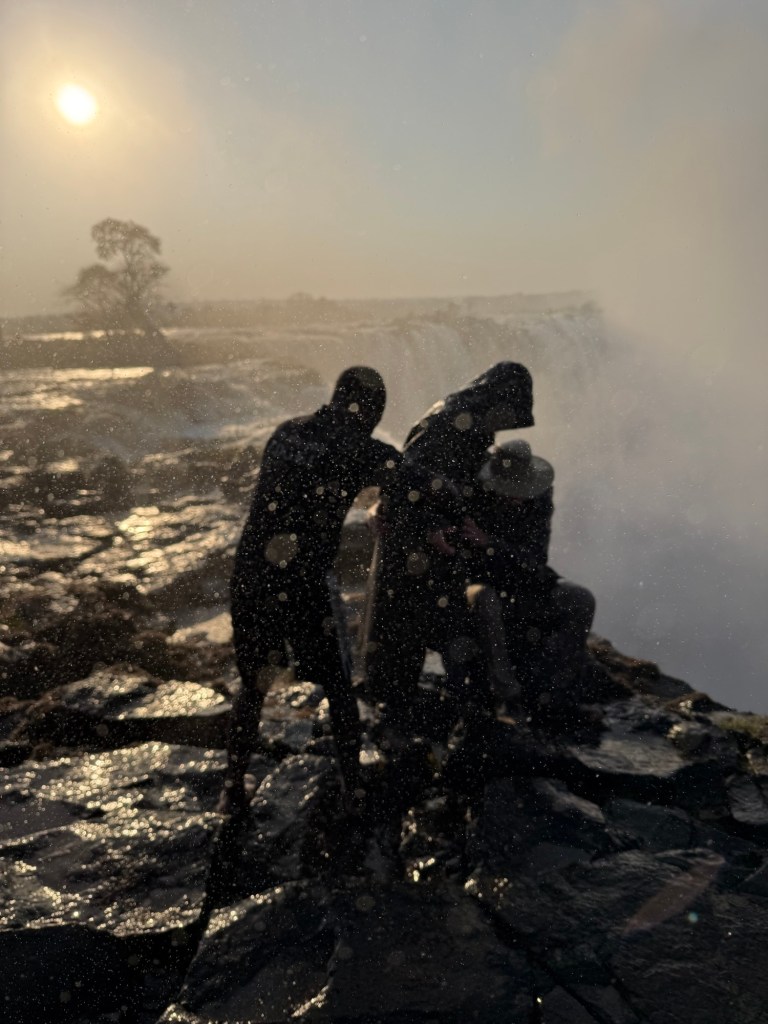
We then climbed down to the lowest observation deck where we were given ponchos to wear. As we walked out, the mist became a deluge of water which the ponchos did little to ameliorate. Clothes were soaked, shoes were soaked and I felt like I had taken a shower. From here another Moonbow was visible.
From the Lower Deck
As we dripped back up the stairs we were greeted with a cold drink of water, and a shuttle back to the hotel.
After a passable hotel breakfast we’re off to the park to see the Argentine side of the falls, and the famed Devil’s Throat. A short walk through the awakening town to the bus station. The bus leaves at 8:00 on the dot. Heat is already building and humidity is high. At the park entrance we buy our tickets then enter the park and head directly to the train station, where a small green trolley carries us to the Devil’s Throat walkway.
The Train
The Devil’s Throat is the highlight of the park for most people. A raised metal walkway very similar to the setup at Parque Glaciares crosses over numerous braids of the Iguazu River to the viewing platform over the waterfall; it looks like a giant hole, pouring water in from all sides.
The Devil’s Throat
We then walked the upper trail to get views of numerous other falls pouring into the river below.
More waterfalls And More
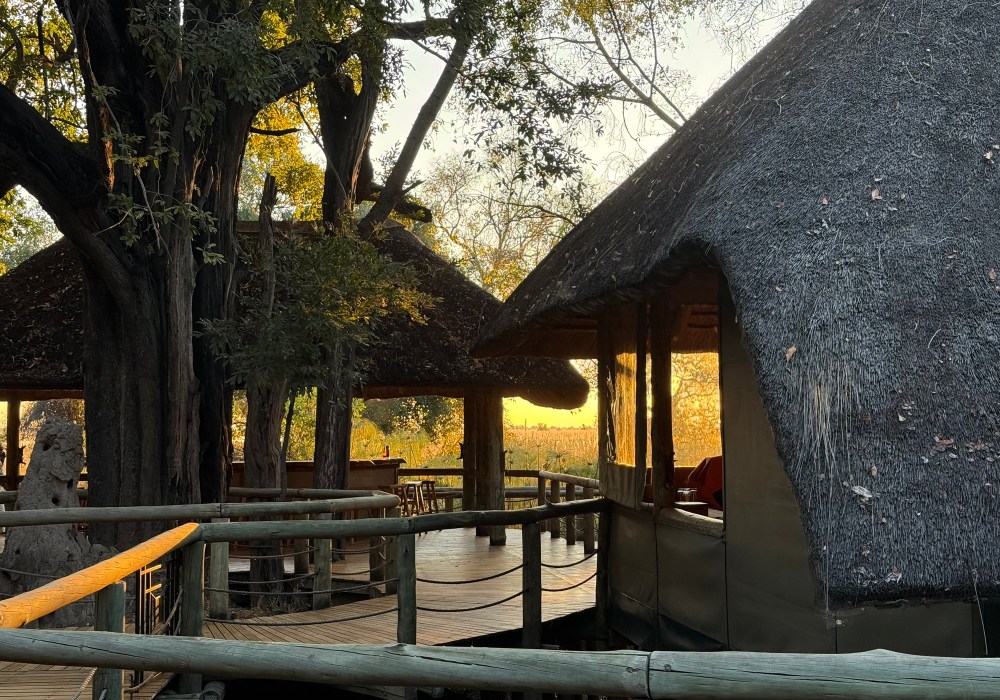
After touring the Argentine side of the falls we took the bus back to town and had a light lunch by the pool while we waited for our driver to take us to Brazil. The border crossing was relatively easy, especially with our driver herding us through. Argentina, Brazil and Paraguay have a thirty kilometer duty free zone around the border, and shoppers from all three countries visit to get bargains in the zone, so they have a robust border crossing service to accommodate them. Once we crossed into Brazil it was a short ride to the Hotel de Cataratas overlooking the falls from the Brazilian side.
Hotel de Cataratas
Tonight we’re hoping to see a rare event, a full moon over the falls and a Moon rainbow.
There is a finger of land in far northern Argentina called Missiones Province that shares a border with Brazil and Paraguay.
Iguazu Falls, created as the Iguazu River flows through a basalt canyon is the world’s largest waterfall system, featuring over 275 cascades along a 2.7 km span on the Argentina-Brazil border. Over 80% of the falls are on the Argentinian side, but the most panoramic views are on the Brazilian side.
We’re flying into Puerto Iguazu to spend one day on the Argentine side, and then spend two days on the Brazilian side. Based on past experience at Aeroparque Jorge Newberry we’re anticipating long lines and chaos, so we get there almost three hours early to find the airport largely empty. We check our bags, then have a leisurely breakfast of avocado toast with an egg, and coffee.
At the airport At the Other Airport
We are across the river from Brazil, and this feels completely different than the rest of Argentina. The jungle is out there. Cash is king, but we fail in our efforts to find a Western Union office; three are listed on Google Maps, but none are there. Helpful shop owners keep directing us to the next street over, and over. We finally find a Cambio, and try to change perfectly good $100.00 dollar bills, but the sullen clerk finds microscopic flaws with each one. Tiny tears, a bit of red ink on the bill. She finally glances briefly at one bill and accepts it.
Flush with far from perfect Argentine pesos we head back to the hotel. The rooftop bar and pool is thumping with Techno House music and the Caiparhinas are strong. We watch the sun set and the moon rise over the Iguazu River. Tomorrow we’re going to the Devil’s Throat.
My alarm rings at 5:30 AM but doesn’t wake me. It’s playing bird songs, and Melissa thinks it’s birds outside. She turns on her Merlin bird ID app but can’t seem to identify the birds. She’s confused, and wakes me up. I tell her the birds are my alarm. She’s not amused, but I am.
We’re taking the Buquebus ferry to Colonia, Uruguay this morning and will have to get there two hours before departure to go through security, customs and immigration. Or so we are told. In fact, we get there two hours early then wait an hour before the security line opens for our boat. So we have a cappuccino and sit. Then it’s the usual security, customs and immigration. We are face scanned, fingerprinted and finally OK’d to leave Argentina. The Uruguayan border guard takes a brief look at us and stamps the passport.
Colonia, full name Colonia del Sacramento, is a historic town across the river Plata from Buenos Aires founded by the Portuguese in 1680. It is the oldest town in Uruguay. Today it entertains tourists with stone walls, cobbled streets, restaurants and tchotchke shops. Most are day visitors from Buenos Aires who take the ferry across in just over an hour.
Colonia Lighthouse
As we walk through the town, I am reminded of St. Augustine, Florida, which was founded in 1556 by the Spanish, and has the same walls, cobblestones and stucco buildings. And also the same restaurants, hotels and tchotchke shops. Colonial history in a bottle.
The church
We have a nice lunch at Charco, then visit the shops again. Melissa finds a wooden tango carving. The day is hot and we buy some water. Currency can be an issue, and the shops won’t take Argentine pesos, but I have been using the Wise App, and can quickly get some Uruguayan pesos on my phone. Transaction approved. This is travel in the 21st century.
Keepsakes for sale
We head back to the ferry terminal to get our boat, once again through customs and immigration and security. Back to Buenos Aires. Tomorrow we’re going to Iguazu Falls.
Florida street in Buenos Aires is a half mile pedestrian only shopping area, including small boutiques, fast food and a shopping mall. As you walk the street there are dozens of people calling out “cambio, cambio” or “change money”.
The cambio is a black market money exchange primarily looking to change pesos for dollars. They will typically give you a better exchange rate on the dollar than the bank, or official rate. This is known as the blue rate, and during times of high inflation it can be significantly higher than the official rate. But the cambios also are known to be scammers who pass counterfeit bills or otherwise cheat unsuspecting customers. The blue rate currently is only slightly higher than the official rate, so the cambios didn’t seem to be doing much business.
Florida Street
There is a very nice shopping mall on Florida Street, and we walked in to find many typical US brands, including Levi’s and American Tourister as well as local brands selling everything from gaucho wear to lingerie. Melissa found a couple of dresses, and I bought a linen shirt. We’re not sure how we can get them in our already overstuffed bags.
We had a nice sandwich of burratta, sun dried tomatoes and prosciutto on focaccia bread at a salumaria near our hotel. Then, afternoon siesta.
As the day cooled off we went for a walk through the park to the clock tower and visited the train station. The main entrance is closed for renovations, but it is a classic early 20th century building. On the walk back through the park there were scores of children playing on the playground. Occasionally a homeless person and the strong smell of urine remind us we’re in a big city.
We find a really good pizza place called Pizza Nika and order a pie. The waiter is from Russia.
Walking in the park Pizza NikaTorre Monumental The Train Station
After traveling through Argentina for nearly a month, I thought we were well attuned to the culture. Then I encountered the Cubierto. In Buenos Aires, although nowhere else in Argentina, restaurants will put a charge on the bill called the cubierto which is supposed to cover the cost of incidental items such as bread and water, the cutlery, and the table linens.
After a particularly uncertain meal, where half the order was missed and the other half was wrong, I carefully scrutinized the check to make sure we weren’t charged for items not received. That’s when I noticed a 7000 peso charge I didn’t recognize. I told our waiter this was an error on the bill. He looked uncomfortably at me and said “is cubierto “
“But we didn’t order any cubierto”
“No, is included”
“We didn’t get any cubierto with our meal”
“Yes, is included”
Then the manager stepped in to say the cubierto was for our bread and water .
“But we didn’t order bread, and we paid for sparkling water”
“No, this is the cubierto, everyone pays it for bread and water”
“But I don’t think I should have to pay for bread you brought me without asking “
“It’s the cubierto”
Melissa stepped in and told me to just pay it, it’s only 4 dollars.
“Fine, I’ll pay, but I’m not leaving a tip”
I paid.
I fumed.
I researched the cubierto until I understood the concept.
Melissa told me to go back to the restaurant and apologize. And to give our waiter a tip.
We’re abandoning our plan to visit Montevideo and Uruguay. We’ve been on the road for nearly a month, and the constant packing and unpacking, the airports and the chaos have worn us down. We’ve decided to stay three more nights in Buenos Aires before a trip to Iguazu Falls and Brazil. We’ll Uber to a new hotel this afternoon, after a final lunch with Doug and Kip.
After a good night’s sleep we walk to Western Union for a currency exchange, then stop at a corner coffee shop for cappuccino and croissants. It’s already hot, but may be less humid. We then tour the nearby Japanese garden before walking to Don Julio for lunch.
The Japanese Garden
We walk through another garden along the way, and meander through. The shade feels good and the walk is pleasant.
Jardin Botanico Carlos Thays
Don Julio is an institution in Buenos Aires, and they play it up. A free glass of champagne on arrival, waiters handing you a cloth napkin using tweezers, a wine list five pages long. It’s over the top, and it’s expensive. On telling our hotel clerk we were going to Don Julio, his response was “Why you go there? It’s too expensive ! ” we eye the menu carefully and find we can make a good lunch out of a couple of salads, empanadas, and fries along with one of their cheapest bottles of wine. The food is good, the waiters are no doubt disappointed.
Don Julio
After the lunch and a short walk to a park, we say goodbye to Doug and Kip. They’ve gotten more bad travel news, their train to Albany has been cancelled. At least their flight to JFK is on time.
A Last Lunch
We then Uber back to our old hotel, grab our bags and Uber to the new place Palacio Paz Hotel, which is in a nice part of the city near Plaza General San Martin. Time to get some clothes washed.
The heat was already building when we left our hotel. First stop was Western Union to get some cash. Dollars for Pesos, no problemo. Off we go on the hop on, hop off bus tour of the city. The double decker bus is a little more modern than the 1956 Roadmaster in Ushuaia. The upper deck has an open viewing area, and an enclosed and air conditioned section. We opt for the air conditioning, but it’s not very comfortable. A window is open and hot air is pouring in. After a few stops the other passengers exit and we close the window. Things start to cool down as we ride through the city. We see the Casa Rosado, which is the seat of government in Argentina.
Casa Rosado
We also see churches, the National Bank, and statue upon statue of everyone from Juan Peron to Gandhi. We finally get off at the Caminito neighborhood, with its garishly painted buildings, and have a good food truck lunch and watch a couple Tango by the river.
Asado by the RiverWith Tango
After our lunch we start walking toward our hotel. We pass the soccer stadium in blue and gold, La Bombanera, where the Boca Juniors and such stars as Lionel Messi play. Every bar and shop in the area is painted the same Blue and Gold.
La Bombonera
The walk back is longer than anticipated, so we call an Uber and ride back in air conditioned comfort. After a brief rest we head out to dinner at Rio Alba, an old school BA restaurant. I order the “Mini Carne”, which turns out to be a large and very good steak. We finish with a flan. Delicious! Our waiter, Victor, seems to be enjoying himself as much as we do.
Victor at Rio Alba
A short walk through the park helps us digest. And we get a good nights sleep.
We pack our bags and load up the Hilux. Doug and Kip have left on an earlier flight. They were supposed to fly back to the USA tonight, but a huge winter storm has cancelled thousands of flights, including theirs. They will now fly out two days later, so we’re looking for Tango shows, dinners and hotels in Buenos Aires.
The Dubrovnik car rental man meets us at the airport. He flew in from El Calafate yesterday, and will drive the Hilux back to El Calafate today, a 900 kilometer journey. He’s young and doesn’t seem to mind.
Goodbye to the Hilux
We enter the airport to find the biggest queue we’ve ever encountered. All the cruise ship passengers are leaving today, and we must be on the same flight. Somehow Aerolineas Argentinas has switched planes, cancelled our flight and put us on a new flight without letting us know. The new flight leaves an hour later and flies into EZE, the larger international airport in Buenos Aires rather than flying into Aeroparque Jorge Newberry, which is much closer to our hotel.
We arrive at the hotel just in time to change and head out to the Tango show. We go to Tango Porteno, which is in a beautiful Art Deco theater, and includes dinner and a show. The meal is not bad, and the show is fantastic.
Dinner and a show Tango Porteno
It’s almost midnight when the show ends and we are tired from our travels. Uber back to the hotel for a good night of sleep.
The day started cool and windy, but with a beautiful sunrise over the Beagle Channel. Things get rolling slowly, but we’re finally out the door by 11:00 AM. Our plan is to take a boat tour of the Beagle Channel and see the “End of the World” lighthouse. We walk to the kiosks to see what’s available. Three cruise ships docked overnight, so the town is busy.
Sunrise over the Beagle Channel
We find a three hour tour (Oh Noooo!!!) leaving at 3:30 on the Catamarán Ezequiel and buy tickets. With time to kill we do a bus tour of Ushuaia, which proves to be fun and informative. The bus is a double decker 1956 Routemaster billed as the southern most Routemaster in the world and was probably once a London bus.
1956 Routemaster bus
The tour winds its way through the city, pointing out the first Catholic Church, the oldest school and the house of a notable writer who lived in Ushuaia. A lot of the stories relate to the former prison, as Ushuaia started as a penal colony. An escaped prisoner supposedly hid in the bell tower of the Catholic Church, and was only found when the priest discovered that all the sacramental wine was missing.
We stop at Laguna del Diablo, a small pond the locals skate on in the winter.
Laguna del Diablo
The tour ends by the waterfront, but we still have an hour before our cruise, so we go to a nearby food truck for a choripan , which is grilled sausage topped with salsa and chimichuri and served on a toasted roll. I thought it was delicious. Melissa and Doug thought it was undercooked.
Finally we boarded the Ezequiel for our Beagle Channel cruise. It was still windy, but the sun was emerging from the clouds and it was nearly 60 degrees.
Onboard the Ezequiel
The Beagle Channel was named after the British ship of Charles Darwin fame, although not when Darwin was aboard. It marks the boundary between Argentina and Chile and is the passage from Ushuaia into the Antarctic Ocean and continent. There are numerous islands in the channel, some of which have been disputed by Argentina and Chile in the past. Rocky islands are covered with flocks of Antarctic Terns, cormorants and other species. Sea lions loll on the rocks.
The most famous landmark in the Channel is the Faro Les Éclaireurs, the so called lighthouse at the end of the world. We cruise past the lighthouse and the Captain deftly spins the ship so everyone aboard gets a good view.
Faro les Éclaireurs
As the cruise continues a group of rowdy passengers moves toward our seats. A large woman with inflated lips tries to bully Kip into moving, but Kip stands firm. A glass breaks, but doesn’t slow their partying. Tension fills the air. A couple across the aisle, she also with inflated lips and a perpetual pout, takes endless selfies, while a young girl with them stares straight ahead, face void of expression. The trip is nearly over. We have held off the intruders and head out triumphantly for pizza. Last day at the end of the world.